Showing posts with label business. Show all posts

How HDB flats are priced affordably


HDB adopts a market-based pricing approach so as to reflect the true subsidy that buyers enjoy. Under this approach, HDB determines the market value of the flat, based on its location, finish and other attributes. Then, it sells the flat at a discount to the market value. HDB buyers understand this, and appreciate that new HDB flats are priced lower than resale flats. Similarly, when they want to sell their flat in the open market, they do so at the prevailing market value, not at their cost of purchase of the flat.

We also wish to highlight that this approach has enabled HDB to continue to price its flats affordably despite the current sharp escalation in construction costs. Currently, a new four-room flat can cost close to $300,000 to develop, taking into account land, building and other costs. This is significantly higher than the subsidised price of a four-room flat in Punggol/Sengkang sold by HDB at about $200,000 to $260,000.

Source: How HDB flats are priced affordably

This is the story that's getting a lot of heat lately. I've managed to dig up a cartoon I drew in January 2007.
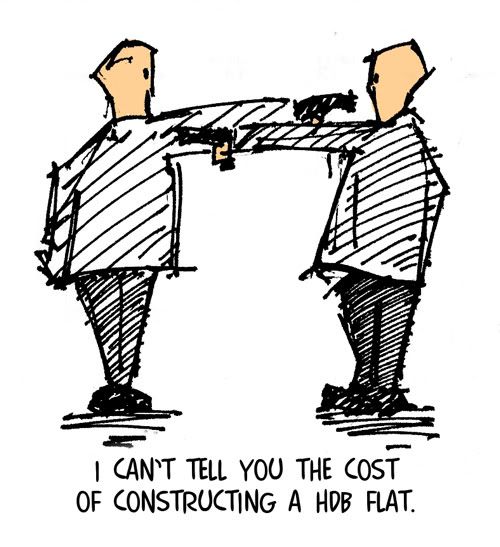


Readers are getting very annoyed at the revealed cost and demands a breakdown. If it's a minority who are in disagreement, it's probably no big deal. But when it's a majority, you can be sure where the problem lies with. I'm also very interested to find out because I find it highly suspicious that HDB is actually revealing the cost of construction.

My belief has always been from a macro economic viewpoint. If you keep the property prices high, people will have to work harder. That's essentially good for the economy.

Essentially, people are angry at the lack of information that HDB has been providing , or should I say not been providing, all these years.

The solution for HDB is very simple. This is just essentially a marketing or PR problem. I hope they do realise that this is a marketing problem in the first place.

First, stop beating around the bush and state the real cost of building a HDB flat, with the cost breakdown.

Secondly, don't be afraid to tell people the profit margin on each flat. There has to be a profit margin or else who would built the housing? Tell people that, loud and bashfully.

Third, listen to people and answer their damn questions straight. Understand that people can say whatever they want. Whether you want to implement it is another thing altogether. There's nothing the people can do except earn more money.

Fourth, educate the public on the concept of value. Value is the perceived benefit over the sales price. If you cannot change the sales price, improve the perceived benefit. It's basic marketing. It's like Starbucks is not selling coffee and Ikea is not selling furniture. If not, there's no chance in hell people will pay that kind of price and not complain.

Sometimes it's not about the price, it's about the value. Simple analogy, just because one's a millionaire doesn't mean one has to buy an orange for $10.

There's nothing to hide, unless there is something.
Even God Needs Accountability

I'm so damn right.

SINGAPORE: Head of Ren Ci Hospital, the Venerable Shi Ming Yi has been charged with alleged forgery, conspiracy and misuse of funds.

Venerable Ming Yi, who was also former Ren Ci Chairman, was slapped with 10 charges Tuesday morning.

Source: Channelnewsasia

On 24 Oct 2007, I wrote the following, with the title "Even God Needs Accountability:

If accountability isn't important, I hope these news will make you think a bit harder.

I have written something about accountability a few days back also. And it seems that this theme is coming back.

The following is not meant as an insult to any religious group. Ok, say you have god running your company now. Normally on fine days, he's running the business well. He has all the decision power to make investments for the company. He' friendly with colleagues, delivers results and likes walking his dog. At the end of the financial year, everyone gets their bonuses.

"Hey, that guy is good. Thanks to him we have bonuses," says one coworker.

"Isn't it dangerous for him to have that much power and nobody is looking over his shoulders?" said a new employee who had just graduated from NUS.

"Are you nuts? Did you not receive your bonus this year? Isn't the company doing well? What are you trying to imply" replied the coworker with a little hostility.

"But what if one day he wants to try something naughty?" said the new employee.

Everyone looked at the new employee and wonder what the hell is wrong with him. Couldn't figure it out, they walked away. Suddenly, he's left standing alone beside the water cooler.

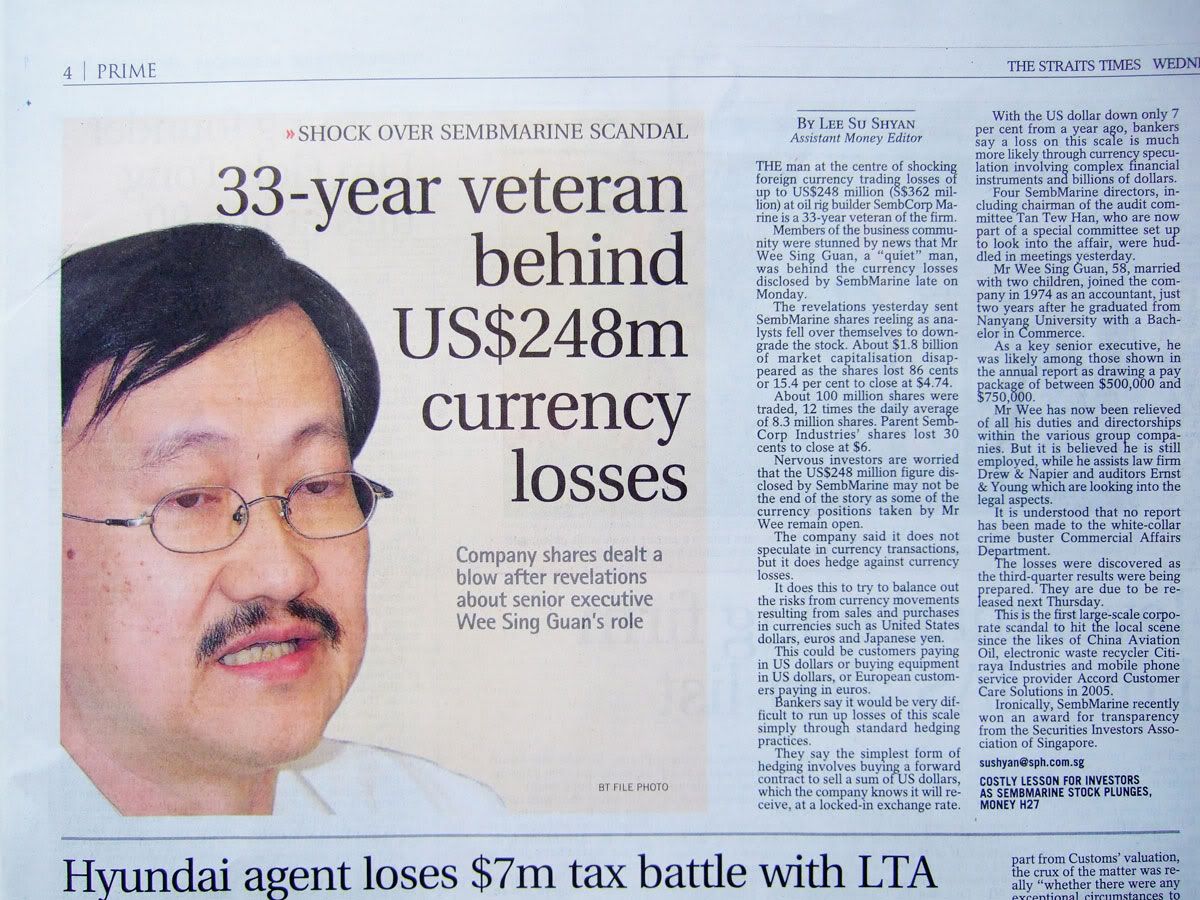
The thing is, even if you're god, suppose that one day you do decide to do something naughty to the company. Think investing $1 billion dollar into foreign exchange without consulting anyone, because you think you're smart enough and there's not need to consult anyone. And nobody was assigned to look over your shoulders. One day, the foreign exchange crash, the $1 billion dollar vanished, and the company has to go into red for the next few quarters.

Are you still not seeing the picture? If there's no accountability, you won't even know who's doing what to the company's money!

Corporate governance and accountability should be in place in all organisation in Singapore if they are dealing with money, which they WILL be dealing with money. That's the point I'm trying to say.

It's not that I'm paranoid. It's a mechanism meant to protect the company, making sure that the company is doing well financially. That's why you're able to get your bonus at the end of the year.

Why Not Just Put a Fuel Meter?


From July 17, passengers on Comfort and CityCab taxis will have to pay a 30-cent surcharge per journey.

Singapore's largest taxi group, ComfortDelGro, said this is to help its cabbies cope with increases in diesel costs.

Source: Channelnewsasia

Is 30-cents the right amount?

But why not just put a fuel meter that's pegged to petrol prices? This would save trouble deciding the amount of fuel surcharge in the future. Hey, petrol stations have been doing it since they were petrol stations.

And this is my reply should SMRT decide to increase their fares. Go ahead, peg your fixed fares with a fuel surcharge.

AntiSTOMP


This is great. Attacking where STOMP is the weakest, the quality of content.

Malaysia Shouldn't Have Subsidised Oil From Day 1

Source: Malaysia raises petrol prices by 40%

Of course, back in day 1, they probably won't know that oil prices would rise to the heights of today. The point of the lesson is, market forces will determine the price. Economics will still stand.

Why was there a need to subsidise oil in the first place? Sure people might have to work harder to pay for things they need. But what they give, they would receive back in other ways. You learn how to find opportunities to create value and wealth.

Why can't service staff take pride in their job?

Source: Why can't service staff take pride in their job?

Front line staff have to feel that it's right to take pride in their job. If not, they won't take pride in their job.

So when did it feel so wrong?

Was it because your co-workers mock you about the difference it can make to you or your customers? Was it because management didn't provide any incentives for people to feel proud of their jobs? Or was it the job that just doesn't match you?

If the management don't really care, chances are you won't really care as much. It's just as simple as that.

Economics Waking Malaysia's Oil Ban On Foreigners

Source: Malaysia shelves plan to ban foreigners buying subsidized gasoline
"We have to find a new effective date because there are other matters, like for example, can we have separate pumps because the Singaporeans are saying that they don't mind paying the market rate," he said.

Full story here


From the first minute I read the news release when Malaysia said it's going to ban foreigners from buying petrol, I knew this would happen. Now they are going to sell their petrol at market prices.

This is just basic economics. Elementary.

And here's my original post, 5 days ago.

Yahoo Auctions Singapore Might Really Be Going Down


I won't be surprised if Yahoo Auctions Singapore goes down. Ever since they closed their US auction site on 2007, I have a feeling that this might happen.

Few months ago, my account, with over 190 ratings, stopped functioning properly. Managed to post something but the item couldn't be found when doing a search. Today, searches done on the site returned with no titles.

Emailed their support staff on my account issues and they replied they were working on it. After multiple weeks, I've given up.

But the auctions sites, the other one is Hong Kong's, are least on Yahoo's mind right now. I don't even know if they are going to fight Microsoft or work with them.

After all, auctions isn't their core business.

Guess it's time for me to hop over to eBay Singapore. Wait, I've an account there already.

88% Exceptional Execution of an Ordinary Idea


Two interesting quotes that I spotted on Time's Myth of the Fearless Entrepreneur.

Columbia University business professor Amar Bhidé found that only 12% of growth-company founders surveyed attribute their success to an "unusual or extraordinary idea"; 88% reported that their success was due mainly to "exceptional execution of an ordinary idea."

E.g. If you have Steve Jobs, Bill Gates and Richard Branson are working together to start a company regardless of what they are selling, you'll probably want to invest in it.

The evidence suggests that as entrepreneurial leaders become more successful, there is a tendency for them to become more risk averse--a concept called "loss aversion" made famous by Israeli psychologists Daniel Kahneman and Amos Tversky, who studied behavioral economics.

Well, there's more at stake on the table.

Singapore inflation rate hits new 26-year high of 7.5% in April


Singapore's annual inflation rate rose to a new 26-year high of 7.5 percent in April as food, housing and transportation costs soared and is now a risk to the economy, the government said on Friday.

Story continues at Singapore inflation rate hits new 26-year high of 7.5% in April

This increase in inflation is particularly frightening, especially to poor people, whose food budget is often a percentage of their monthly income.

If the inflation carries on, I wouldn't be surprised to see the Government call out to companies to increase employee wages. That would be the most drastic situation I see.

The other way, mentioned in the story, is to strengthen the Singapore dollar.

That would in effect mean increasing the cost of doing business in Singapore. Exports will suffer. But current oil prices are already increasing the cost of doing business.

It would be very interesting to see how MAS tackles this problem.

HDB targets frivolous applicants


News source: HDB targets frivolous applicants

THINK hard before you apply to buy a new Housing Board flat: Lodging frivolous applications will now get you sent to the back of the queue.

New HDB rules unveiled yesterday target flighty first-time buyers who have been hedging their bets by applying for flats when they often have no intention of closing the deal.

The HDB said the move 'will encourage applicants to consider their options carefully'. It also addresses concerns that the thousands of applications that pour in for HDB projects bear little relation to the actual take-up rate.

...

Read the rest of the story here


I don't really see what's the problem with people adopting the apply-first-and-see-how attitude. If you don't like the flat, you should have the right not to buy the flat. You're not buying a bowl of fishball noodles. The flat cost many times your salary. The buyer should be at least entitled to a moment of painful doubt.

If it cost many times your salary, the 1 year penalty is relatively light compared to the hundreds of thousands of dollars.

Again, how will this help the genuine buyers? Or how does the frivolous applicants hurt the genuine buyers? If buyers before them backed out, these genuine buyers would naturally move forward in the queue. Of course, your choices might be limited because you're still somewhere at the back. But hey, you're now presented with an opportunity you previously had not.

It's funny. Would the policy makers themselves buy a flat they do not like? Do they actually talk to people who are going to be affected by their policy?

Blu-ray XBox 360 In the Future?


Well, it really depends on how much Microsoft thinks their XBox 360 gamers are using their console to watch Blu-ray movies.

What's the motivation for Microsoft to have an in-built Blu-ray player for their XBox 360 anyway? Even though HD-DVD was dropped, that doesn't mean HD-DVD games are going to die. Unless, the cost of producing games in HD-DVD is going up, or the cost benefit of having games in Blu-ray disc are better, there's really no reason why XBox games can't still be stored in HD-DVD.

StarHub 'blocking file-share program'

News source: StarHub 'blocking file-share program'

From a business perspective, it makes sense to block BitTorrent file-sharing. It is however a different story if you're touting a 8Mbps when you're getting an average speed of much less. It's not misrepresentation, sadly, since theoretically the speeds can reach 8Mbps.

Starhub has to disclose that they are blocking BitTorrent file-sharing or is capping download speeds for whatever application. Failure to disclose information, when seen in a bad light can just mean deceiving their consumers. This is very evidently seen as it even made it to the news.

What Starhub is doing is not wrong. It's just that consumers what want they are paying for. If they can't get it, why are they paying?

Will Saving Money Make Me Rich?

Do I put aside my salary for savings each month? I do, although I don't really have an amount set out in mind.

It's not that I like saving, it's just that I don't like spending money. I'm not a shopaholic. During my US trip to New York last year, I bought only 1 polo t-shirt. That's right. ONE t-shirt. Had some problems even when deciding to buy it because it's not that I can't get it in Singapore.

Recently during reservist in-camp training, a friend said that everyone can be a millionaire if they save on their $2000 per month salary. After deducting $500 for utilities and stuff, that's about $1500 per month of savings. That would take 55 years to make you a millionaire. Of course, your salary might increase overtime to give you a savings of $2500 per month, that will make it 33 years.

Technically speaking, you can be a millionaire. The variables here are time and salary. Saving money is much more easy than making money. If you have a dollar, you can save. But before that, you'll have to make that dollar. You cannot save money without first making it. Therefore, saving money is less important to making you rich, relative to making money.

Then you have to take care to earn more than you spend. The super rich make more than they can spend.

Rather than taking the slow way to become a millionaire, through savings, I would rather take the supposedly faster way of finding ways to increase my income.

Also, a rich person has the skills necessary to become rich. It's important to have that skill. It also goes in line with my thinking that it's not what you have, but what you do. If you're a poor guy with great business sense, you'll be rich in the future even if you're poor now and have nothing.

I wonder what will I think of this post in the future when I'm reading this.

$23K Housewife Fantasy


That's what housewives really earn if they live in a fantasy.

Well, $23K is the high end. $8K is the low end. For the high end, I guess you're probably taking care of Donald Trump's kid.

The numbers are abysmal.

You're only worth as much as your next pay cheque. That being said, those HR executives should really help these housewives find these high paying jobs before sprouting such numbers out of their mouths.

Besides, the numbers on the ST photo graphic doesn't add up to $23K. If you just want to single out certain jobs, please say that you're singling certain jobs out.

It's very irritating to read these kind of stories where there's no concrete evidence and everything is just conjecture.

Is It Time for Macs to Go Corporate

(Picture sourced from Flickr)

This week's BW Cover Story podcast talks about the opportunity of Mac gaining corporate sales.

Businessweek story: The Mac in the Gray Flannel Suit and the accompanying podcast download link.

It's pretty easy to know the outcome if you know the principle of technology.

Technology is all about saving time and money.

So is using Mac in the office going to help you save time and money? And what are the alternatives out there compared to the Mac?

Business needs require business software. Are there available software that your business needs? For example, if you're using Microsoft Office on a Windows computer, there is also a Mac equivalent version of Microsoft Office.

Although Macs can run Windows, it will require an additional Windows license (think extra money!). You'll also have to boot up into Windows (think extra time!). If you constantly switch from Mac OS to Windows OS, your productivity will take a hit. Of course you can run Windows OS inside Mac OS via virtualisation, but note again you need to spend extra money again on the virtualisation software.

So if you really need to switch from Windows OS to Mac OS frequently, don't get a Mac. You won't be saving time.

Both Windows OS and Mac OS are pretty stable. But stability not a factor in deciding whether to buy. The factor is whether the stability will translate into time/cost savings. Do you see what I'm trying to say? All the features count for nought if they are unable to translate into time/cost savings.

Some argue that Macs are more expensive. It's a very sound argument. Let's go back to the principle again. Is that expensive Macs going to help you save time and cost more than the less expensive computer?

Note also that there are two variables, time and money. You'll value one more than the other. It's the reason why people pay more for cabs and some take the bus to work.

If I were a CIO for a company, making purchasing decision will take seconds.

Users of computers don't really care about anything else other than getting their job done, and done fast.

I use a Windows computer at work. It used to be a Mac but it didn't support a particular software the new workflow required.

When Did The Negativity Creep In

Had a very interesting talk with a friend yesterday over dinner. Our talk almost always consist of some business related topics. Let me highlight just one that I think is very interesting and true.

We were talking about the negativity that surrounds Singaporeans when it comes to starting a business or making money.

The first thing that comes to mind when I ask anyone about the possibility of starting a business would be cost. How much is it going to cost running the business? What's the startup cost? How much will it cost to run everything? I don't come from a rich background to fall back on when the business fails.

See anything similar in the responses? All they think about are the forces that are out to take the business down. They don't even have time to stop and think for once about possibility of an opportunity. So adverse are Singaporeans to taking risk.

The problems comes from social conditioning that our education system and parents have put upon us. Most of them will tell you to study hard, find a good and stable job for the rest of your lives. If it works for them, it'll work for you too.

They'll give you examples of people who have studied hard and made good money. But they never tell you the examples of people who made it through to the top with little education. Even if they do, they'll say that those were the exceptions but do they encourage you to be an exception?

After years of conditioning, or brainwashing, one naturally forgets that there are other paths to be taken in life. And this typically takes place when you're in secondary school and slightly later. In the university, if you're lucky, you'll get to meet speakers who actually have been in the world of business and speaks to you about their real life experiences.

Everyone can see negativity so you practically have no advantage over others there. But not everyone can see opportunities.

The Killer Application in iPhone is Safari


Safari is the web browser supplied by Apple for their computers and for the iPhone.

Steve Jobs probably won't want you to install MSN onto the iPhone. But guess what, you can log on to MSN from Meebo.com! Meebo.com supports MSN, ICQ, Yahoo Messenger and etc! All these chat messengers on the web browser! Yes, you can now be online while you're at Starbucks!

Want to work on your iPhone but can't install the applications you want? Now with Google Docs, you can work on word documents, presentations and even spreadsheets. But you probably won't want to do that on a small screen. But it's possible if you want to!

Say you took a photo with the iPhone. You can fire up Flickr.com and instantly upload your photos onto the the Internet. Yes, instant publication and blogging!

Given the tons of rich Internet applications out there, you can practically do anything with a web browser.

You can download songs from Amazon.com. You can book cinema tickets online. You can find the best Laksa or Hokkien Mee on Google Maps. You can search up anything on Wikipedia. You can stream music from Last.fm.

I can go on and on but I know you got my point.

Podcast perfection: Businessweek podcasts


Businessweek.com has one of the best podcasts in the world right now. Just check out the 5 star ratings on iTunes.

I've a couple of hundred BW podcasts in my iPod that I listen every time I commute to work. So much so that the time I spend listening to these podcasts is more than that of what I spend on music.

What makes these podcasts work is because they have personalities. They are character based. The same reason that made the Mr Brown Show podcasts so popular.

Let me take my favourite podcast title of all, Behind The Cover (BTC). BTC is a weekly podcast that takes readers behind the scenes of the cover story. Chief executive editor John Byrne talks with the writer/s who wrote the cover story.

Each podcast is about 10 to 20 minutes. The discussion will touch on how they approach the story and their personal opinion on the topics. You literally go behind the scenes with the writers. You get to know how they tackle their stories. What difficulties they have to surmount and things that they wanted to put on the magazine but can't because of space. Each week, different writers will talk on the podcast, bringing with their their personality on air.

At the end of the podcast, you'll get a clear picture of what happens behind all the story gathering to make up what you see on the magazine. Although you'll probably never see these people in real life, but after the podcast, you will feel as though you have met them.

BW has managed, through the podcast, to break down the barrier of mystery that surrounds the news making industry. But that's not to say that they reveal all the secrets of their trade. But other media companies can definitely learn something useful from them.

I believe


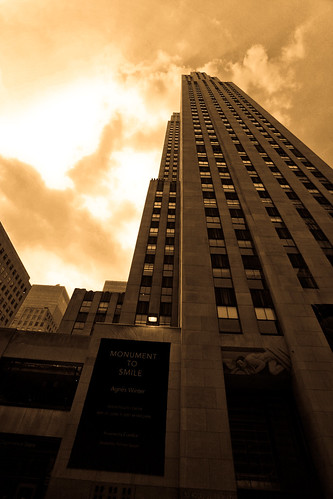
This is a quote from John D Rockefeller in 1941. It's found on the plaque in front of Rockefeller's plaza which I happened to chanced upon. Gives a little insight into what would be the world's richest man if he had still been alive.

- I believe in the supreme worth of the individual and in his right to life, liberty and the pursuit of happiness;

- I believe that every right implies a responsibility; every opportunity, an obligation; every possession, a duty;

- I believe that the law was made for man and not man for the law; that government is the servant of the people and not their master;

- I believe in the dignity of labour, whether with head or hand; that the world owes no man a living but that it owes every man an opportunity to make a living;

- I believe that thrift is essential to well ordered living and that economy is a prime requisite of a sound financial structure, whether in government, business or personal affairs;

- I believe that truth and justice are fundamental to an enduring social order;

- I believe in the sacredness of a promise, that a man's word should be as good as his bond; that character - not wealth or power or position - is of supreme worth;

- I believe that the rendering of useful service is the common duty of mankind and that only in the purifying fire of sacrifice is the dross of selfishness consumed and the greatness of the human soul set free;

- I believe in an all-wise and all-loving God, named by whatever name, and that the individual's highest fulfilment, greatest happiness and widest usefulness are to be found in living in harmony with His will;

- I believe that love is the greatest thing in the world; that it alone can overcome hate; that right can and will triumph over might.

Blog Archive